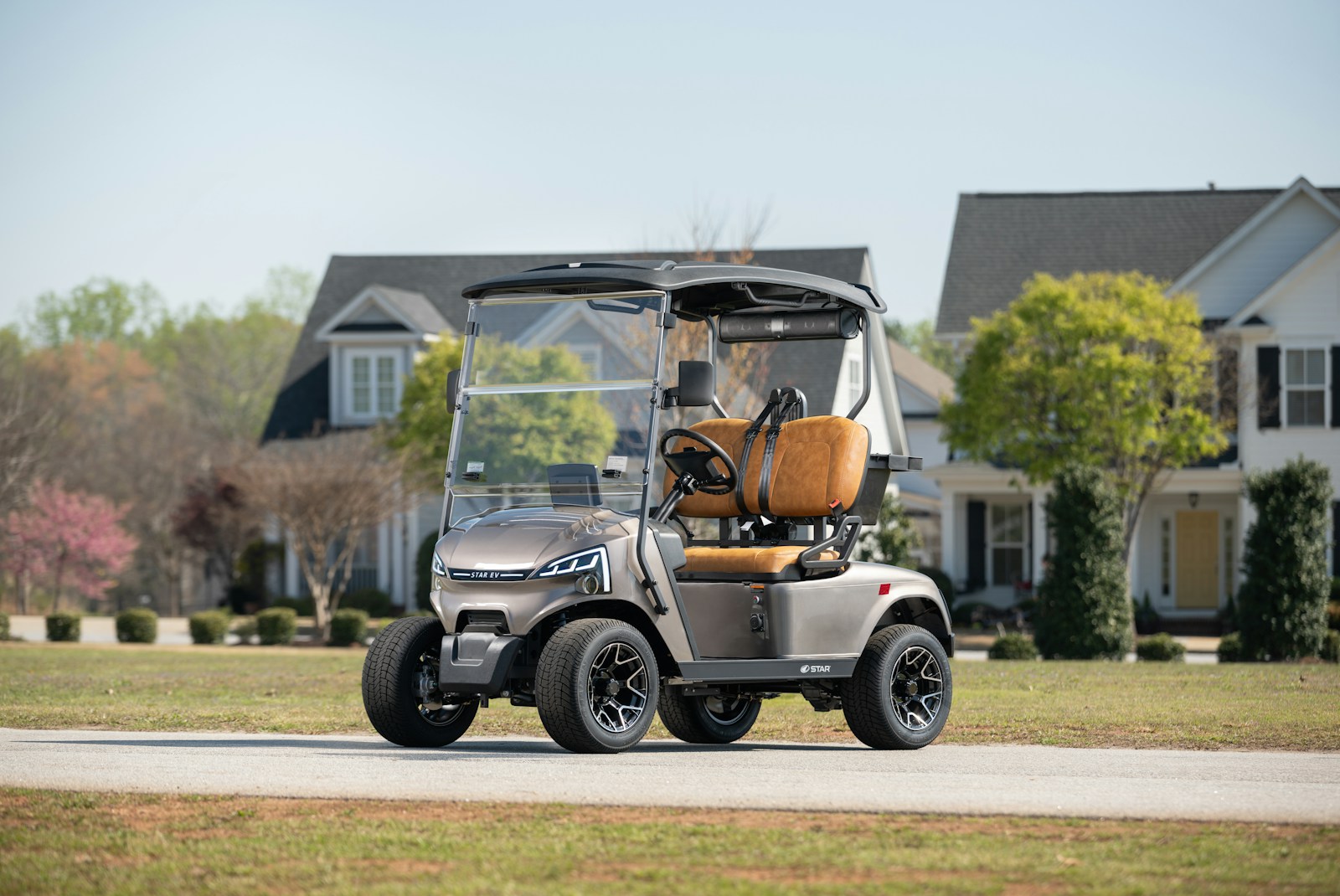
Golf carts and Low-Speed Vehicles (LSVs) are not the same thing under Florida law — and the distinction determines whether a vehicle can legally travel on a public road, be registered and titled, or carry the insurance coverage the law requires. The short answer: a standard golf cart is not street legal on most public roads in Florida. A vehicle that meets the state’s LSV definition, carries the required safety equipment, and is registered as a Low-Speed Vehicle can legally operate on roads posted at 35 MPH or less. For dealers in the Southeast market, understanding this path is the difference between selling a cart and selling a lifestyle vehicle — with a much broader pool of buyers who need exactly what you’re offering.
Florida’s Two Tiers: Golf Cart vs. Low-Speed Vehicle
Florida law draws a hard line between the two classifications. Under Florida Statute §316.212, a golf cart is a motor vehicle designed for operation on a golf course or for recreational use that cannot exceed 20 MPH. Golf carts may be operated on certain designated roadways under a local government ordinance, but only where the posted speed limit is 30 MPH or less — and only on roads that a municipality or county has specifically authorized for golf cart use. They are not required to be titled or registered with the state, and standard personal injury protection (PIP) insurance does not apply.
A Low-Speed Vehicle, defined under Florida Statute §316.2126, is a four-wheeled vehicle with a top speed greater than 20 MPH but no greater than 25 MPH. LSVs must be titled, registered with the Florida Department of Highway Safety and Motor Vehicles, and insured with PIP and property damage liability coverage — the same basic requirements as a standard automobile. In exchange, LSVs can be operated on any road posted at 35 MPH or less, statewide, without a local ordinance required. That’s a materially broader set of roads.
Frank D. Butler, a Florida attorney who specializes exclusively in golf cart cases, has documented extensively that this classification distinction is one of the most misunderstood areas of Florida vehicle law — with real consequences for drivers who operate unregistered, uninsured carts on public roads under the mistaken belief that any cart that looks street-ready is actually legal to drive there. The gap between what a vehicle “looks like” and what it is under Florida law has produced a significant volume of insurance claim denials, traffic citations, and liability disputes.
What an LSV Must Have to Be Street Legal in Florida
The Florida Department of Highway Safety and Motor Vehicles specifies the minimum equipment requirements for a vehicle to qualify for LSV registration:
- Headlights and taillights
- Front and rear turn signals
- Brake lights
- Reflex reflectors (red, on sides and rear)
- A parking brake
- A DOT-approved windshield
- Rearview mirrors
- DOT-approved seat belts for each seating position
- A Vehicle Identification Number (VIN)
A top speed between 20 and 25 MPH completes the picture. Vehicles that meet all these requirements can be taken to a Florida DMV for LSV title and registration — at which point they’re legally registered vehicles, not carts, and the road access and insurance framework changes accordingly.
The Market This Creates for Southeast Dealers
The practical impact of the LSV framework is enormous in Florida, and it’s why the Southeast is the fastest-growing golf cart market in the country. The Villages, Florida — the largest active adult community in the United States — has an estimated 85,000 golf carts operating across more than 100 miles of dedicated pathways. That figure represents a community where a golf cart or LSV is, for many residents, a primary daily transportation mode — not a recreational accessory.
That demand pattern is replicating across Florida’s Sun Belt communities. Purpose-built age-restricted developments, gated resort communities, and urban infill neighborhoods with low-speed internal street networks are all generating demand for premium electric vehicles that can be registered as LSVs and operated legally on public roads. The buyer isn’t looking for a utility vehicle — they want premium features, a real VIN, and the confidence that the vehicle they’re driving is legal, insured, and road-ready.
What This Means for Dealers Evaluating a New Line
For dealers in Florida and across the Southeast, the LSV path is an opportunity, not a complication — if the product you’re carrying actually supports it. Not all carts are built to LSV standards. A manufacturer that delivers vehicles with a VIN, all required safety equipment, and a top speed between 20 and 25 MPH enables you to offer customers a real vehicle — one they can title, register, insure, and drive legally without depending on a local ordinance that may or may not cover the roads they actually want to use.
The questions to ask any manufacturer you’re evaluating for LSV capability:
- Do the vehicles carry a Federal Motor Vehicle Safety Standard (FMVSS) 500 compliant VIN?
- Are all required safety items — seatbelts, windshield, turn signals, brake lights, mirrors — standard, not add-ons?
- Is the top speed between 20 and 25 MPH, as required for LSV classification?
- Has the manufacturer supported other dealers through the LSV title process in Florida?
Boca EV — Powered by PDG Powersports
Boca EV — powered by PDG Powersports — produces a premium electric lineup built for the dealer channel and designed to support the LSV title path. All models run 48V all-lithium, top out at 25 MPH, and come with a 10.1" touchscreen, Apple CarPlay and Android Auto, backup camera, keyless start, wireless phone charging, and four-wheel disc brakes standard across 4-seat and 6-seat configurations in both lifted and lowered builds. The safety equipment required for LSV registration — seatbelts, windshield, turn signals, brake lights, mirrors — is standard on every unit, not a package upgrade.
For a dealership in Florida, Georgia, the Carolinas, or anywhere across the Southeast where the LSV market is active, carrying a line that genuinely supports the LSV path is the difference between selling a recreational product and selling a transportation vehicle to a buyer pool that has both the need and the budget to match. Elegance, Electrified.
If you’re evaluating adding a premium LSV-capable line to your dealership, reach out to start a dealer inquiry.
FAQ
What’s the difference between a golf cart and an LSV in Florida?
A golf cart cannot exceed 20 MPH and is not required to be registered or titled with the state. Its road use depends on local municipal ordinances allowing golf carts on specific low-speed streets. An LSV has a top speed between 20 and 25 MPH, must be registered and titled, must carry PIP and property damage insurance, and can operate on any road posted at 35 MPH or less statewide — without needing a specific local ordinance.
Can any golf cart be converted to an LSV in Florida?
Not straightforwardly. LSV registration requires a VIN issued by the manufacturer to FMVSS 500 standards, plus all required safety equipment standard on the vehicle as built. Most aftermarket conversions don’t produce a VIN-compliant vehicle that Florida DHSMV will title as an LSV. The practical path is purchasing a vehicle from a manufacturer that builds to LSV standards from the factory.
Do LSVs require a driver’s license in Florida?
Yes. Because LSVs are classified as motor vehicles and must be registered and insured, operating one on a public road requires a valid Florida driver’s license — unlike golf carts on designated golf cart paths, which in many communities do not require a license.
What insurance is required for an LSV in Florida?
Florida requires LSV owners to carry personal injury protection (PIP) coverage and property damage liability (PDL) coverage — the same minimum coverage required for standard passenger vehicles. Standard golf cart “insurance” products (often homeowner’s endorsements) are not adequate for a titled LSV operating on public roads. Your dealer can walk you through the appropriate coverage types; your insurance agent should confirm coverage specifically for an LSV-titled vehicle.
Is a 25 MPH electric cart enough speed for Florida communities?
For the roads LSVs are authorized to use — those posted at 35 MPH or less — 25 MPH is functionally adequate. The purpose-built communities, resort neighborhoods, and low-speed connector roads where LSV demand is strongest typically have speed limits in the 25–35 MPH range. The Villages’ community road network, for example, is designed for exactly this speed range. For higher-speed arterial roads, LSVs are not the right vehicle — which is part of what makes them purpose-fit for these markets rather than competing with conventional automobiles.
 — We make IT happen.